Minimum Spanning Trees
Week 13, Wednesday — Prim’s Algorithm
April 2, 2026
Announcements
Warm-up: Graph Representations
Adjacency list (you’ve seen this)
Space: \(O(V + E)\)
Iterate neighbors of \(v\): \(O(\deg(v))\)
Check if edge \((u,v)\) exists: \(O(\deg(u))\)
Adjacency matrix (new today)
| A | B | C | D | E | F | |
|---|---|---|---|---|---|---|
| A | – | 8 | 2 | 4 | – | – |
| B | 8 | – | 7 | – | 2 | – |
| C | 2 | 7 | – | 1 | 3 | 9 |
| D | 4 | – | 1 | – | – | 5 |
| E | – | 2 | 3 | – | – | – |
| F | – | – | 9 | 5 | – | – |
Space: \(O(V^2)\)
Iterate neighbors of \(v\): \(O(V)\)
Check if edge \((u,v)\) exists: \(O(1)\)
Muddy City
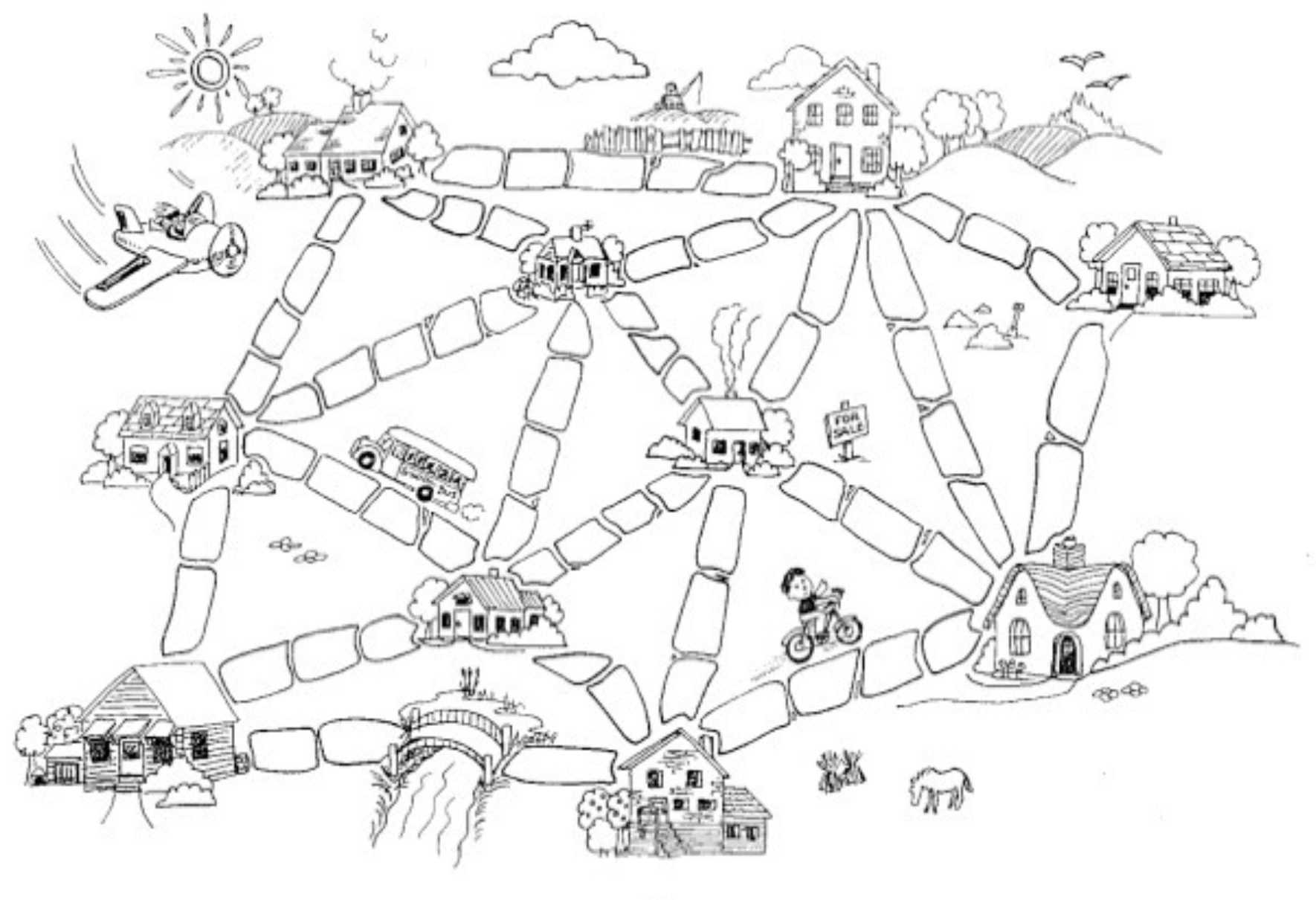
You can pave road segments. Each segment costs its number of paving stones.
Goal: pave the __________ stones so every house can reach every other.
Which roads do you pave?
How many stones total?
Minimum Spanning Tree
Input: connected, undirected graph \(G\) with edge weights
Output: subgraph \(G'\) such that:
- \(G'\) spans \(G\) (contains all vertices)
- \(G'\) is connected and acyclic (a tree)
- \(G'\) has minimum total weight among all spanning trees
What is the MST of this graph?
Total weight = ____
Cycle Property
What’s true about every cycle in this graph?
Theorem: ___________________________________
Proof: ______________________________________
Non-MST Edge Lower Bound
Edge C–F is not in the MST. Using the theorem you just derived — what is the minimum possible weight for C–F?
MST path C → F: _________________
Min weight of C–F: _____
Theorem: ___________________________________
(for any non-MST edge)
MST vs. Shortest Paths
MST minimizes total edge weight — the cost of connecting everything.
Shortest path minimizes the distance between two specific nodes.
These are different objectives.
Partition Property (Cut Property)
Partition Property (Cut Property)
Split vertices into any two sets \(S\) and \(V \setminus S\).
The minimum-weight edge crossing the cut is always in some MST.
Prim’s Algorithm
MST total weight = ____
BFS Revisited
What type is graph? What type is graph[v]?
Running time? (in terms of \(|V|\) and \(|E|\))
- Each vertex enters the queue at most ____ time(s).
- Each edge is examined at most ____ time(s).
- Total: \(O(\)____\()\)
graph |
neighbors |
|---|---|
A |
B, D, E |
B |
A, E, C |
C |
B, D |
D |
A, C |
E |
A, B |
From BFS to Prim’s
The bag determines what the algorithm optimizes:
| Bag | Explores by | Algorithm |
|---|---|---|
| Queue (FIFO) | distance from source (hops) | BFS |
| Priority queue (min edge weight) | cheapest edge to tree | Prim’s MST |
| Priority queue (min total distance) | shortest path from source | Dijkstra’s SSSP |
One change turns BFS into Prim’s:
Replace the queue with a Priority Queue keyed by edge weight. Instead of “which node did I discover first?”, ask “which unvisited node is cheapest to connect to the tree?”
Prim’s Algorithm: Pseudocode
Initialize:
for each v:  d[v] ← ∞,  p[v] ← null
d[s] ← 0
Q ← min-PQ of all vertices, keyed by d
while Q not empty:

  v ← Q.removeMin()

  for each neighbor w of v:

    if w ∈ Q and cost(v,w) < d[w]:
      d[w] ← cost(v,w)
      p[w] ← v
      Q.decreaseKey(w, d[w])

return p
Prim’s Algorithm: Design Choices
Initialize:
for each v:  d[v] ← ∞,  p[v] ← null
d[s] ← 0
Q ← min-PQ of all vertices, keyed by d
while Q not empty:
  v ← Q.removeMin()
  for each neighbor w of v:
    if w ∈ Q and cost(v,w) < d[w]:
      d[w] ← cost(v,w)
      p[w] ← v
      Q.decreaseKey(w, d[w])

return p
What design choices do we need to make?
Put a ⭐ by __________________ operations.
Put a 💜 by __________________ operations.
Prim’s Algorithm: Runtime Analysis
Initialize:
for each v:  d[v] ← ∞,  p[v] ← null
d[s] ← 0
Q ← min-PQ of all vertices, keyed by d
while Q not empty:
  v ← Q.removeMin()          ⭐
  for each neighbor w of v:  💜
    if w ∈ Q and cost(v,w) < d[w]:
      d[w] ← cost(v,w)
      p[w] ← v
      Q.decreaseKey(w, d[w])  ⭐

return p
⭐ \(n\) removeMins + \(\leq m\) decreaseKeys
💜 \(O(m)\) total (adj list) | \(O(n^2)\) total (adj matrix)
| Adj matrix | Adj list | |
|---|---|---|
| heap | \(O(n^2 + m \log n)\) | \(O(m \log n)\) |
| unsorted array | \(O(n^2)\) | \(O(n^2)\) |
Which is best? Depends on graph density:
- Sparse (\(m=O(n)\)):
- Dense (\(m=O(n^2)\)):
Prim’s Algorithm: Python
import heapq

def prim(graph, start):
    """graph: {vertex: [(neighbor, weight), ...]}"""
    d = {v: float('inf') for v in graph}   # cheapest edge to reach v
    parent = {v: None for v in graph}
    d[start] = 0
    pq = [(0, start)]                       # (edge_weight, vertex)
    visited = set()

    while pq:
        cost, v = heapq.heappop(pq)
        if v in visited:
            continue
        visited.add(v)

        for w, weight in graph[v]:
            if w not in visited and weight < d[w]:
                d[w] = weight              # just the edge weight (not cumulative!)
                parent[w] = v
                heapq.heappush(pq, (weight, w))

    return parent   # MST as parent pointers