Dictionaries are Python’s key-value lookup structure.
Beware: KeyError!
Why Dictionaries?
Lists: Access by position (index)
fruit = [("apple","red"), ("banana","yellow"), ("cherry","red")]fruit[0], fruit[1], fruit[2] # How do you look for "apple"?
Dictionaries: Access by meaningful key
fruit = {"apple":"red", "banana":"yellow", "cherry":"red"}fruit["apple"], fruit["banana"], fruit["cherry"] # Self-documenting!
Dictionaries are also fast — We hope for O(1)…
Dictionary Patterns
Pattern 0: Records
Alternative to a data frame or named tuple:
Pattern 1: Membership
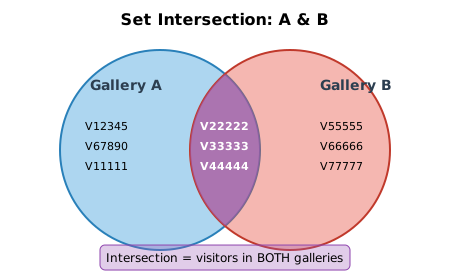
Find everyone who was in Gallery A and Gallery B.
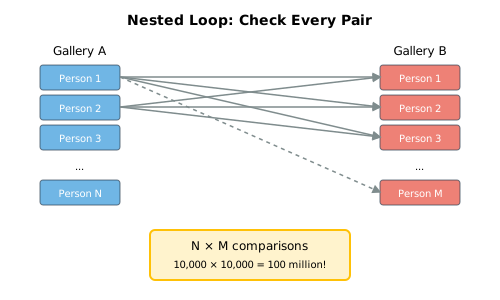
The Naive Approach: Check Every Pair
This works… but what if the lists are LONG?
The Problem with Nested Loops
With 10 people in Gallery A and 12 in Gallery B: 10 × 12 = 120 comparisons
With 10,000 in each: 100,000,000 comparisons!
Pattern 1: Membership with a Dictionary
Why Is This Faster?
Step 1: Look at each Gallery A person once → 10 operations
Step 2: Look at each Gallery B person once → 12 operations
Total: 10 + 12 = 22 operations (not 120!)
Dictionary lookup is instant — it doesn’t matter how many keys are stored!
The Pattern: Set Intersection
from collections import defaultdictseen_in_first = defaultdict(bool)for item in first_list: seen_in_first[item] =Truein_both = [item for item in second_list if seen_in_first[item]]
Use when: Finding common elements, detecting duplicates
Pattern 2: Counting Frequencies
Use case: Count how many times each item appears.
Pattern 3: Finding Complements
Use case: Find two numbers that add up to a target.
As we scan, we remember what we’ve seen — and check if the complement exists!
Pattern 4: Grouping by Category
Use case: Organize items into categories
Grouping with Dictionaries
What if our items are dictionaries, not tuples?
Same pattern — just access the key with suspect["alibi"] instead of unpacking a tuple!
Let’s Practice!
Open the Data Heist activity. You’ll solve 4 puzzles with LARGE datasets.