Whatever-First Search
Week 6, Monday
February 9, 2026
Recap: The Maze Explorer
Last week, we explored a maze using different containers:
| Container | Order | Behavior |
|---|---|---|
| Bag | Random | Chaotic |
| Stack | LIFO | Go deep, backtrack |
| Queue | FIFO | Explore by distance |
Today: What made this work, and where else can we use it?
Whatever-First Search
Adapted from Jeff Erickson’s Algorithms
The Key Insight
The algorithm structure is always the same.
Three things change:
- The bag: What state do we process next?
- The neighbors: What’s adjacent to the current state?
- The bookkeeping: What do we track about each state?
Designing Your Search: A Checklist
| Question | Your answer |
|---|---|
| What is a state? | |
| What are the neighbors of a state? | |
| What bag should I use? | |
| What do I need to track? | |
| When do I mark visited? | |
| When do I stop? |
Choosing the Bag
| Bag Type | Name | Behavior |
|---|---|---|
| Stack | Depth-First Search | Go deep, backtrack |
| Queue | Breadth-First Search | Explore by distance |
| Priority Queue | Best-First Search | Explore by “goodness” |
Choosing the Bookkeeping
| Question | What to track |
|---|---|
| “Can I reach X?” | visited (set) |
| “How far is X?” | distance (dict: state → int) |
| “What’s the path to X?” | parent (dict: state → state) |
| “When did I discover X?” | discovery_time (dict: state → int) |
| “When did I finish X?” | finish_time (dict: state → int) |
The question determines the data structures.
When to Mark Visited?
Two choices:
Option A (our version today): Each state enters bag once.
Option B: Each transition adds to bag once (so states can appear multiple times).
What Is a “Thing”? (State)
The “thing” in the bag is whatever describes where you are:
| Domain | State (the “thing”) |
|---|---|
| Maze | Room number |
| Grid | (row, col) position |
| Social network | Person |
| Tower of Hanoi | Configuration of all disks |
| Word ladder | Current word |
State = everything needed to know “where am I now?”
What Are “Neighbors”?
The neighbors(state) function says what’s reachable in one step:
| Domain | Neighbors of state |
|---|---|
| Maze | Rooms connected to current room |
| Grid | Cells adjacent to (row, col) |
| Social network | Friends of current person |
| Tower of Hanoi | Configurations after one valid move |
| Word ladder | Words differing by one letter |
The problem defines what “one step” means.
An Example Problem
How do we find the shortest path from S to E in a grid?
Let’s fill out our checklist…
Step 1: What is a state?
| Question | Answer |
|---|---|
| What is a state? | (row, col) position |
| What are the neighbors? | |
| What bag? | |
| What do I track? | |
| When mark visited? | |
| When do I stop? |
A state is a cell: (row, col).
Step 2: What are the neighbors?
| Question | Answer |
|---|---|
| What is a state? | (row, col) position |
| What are the neighbors? | 4-connected |
| What bag? | |
| What do I track? | |
| When mark visited? | |
| When do I stop? |
From (r, c), neighbors are (r±1, c) and (r, c±1).
Step 3: What bag?
We want shortest paths.
The distance from A to B is the minimum number of steps.
How do we explore in order of distance?
Why Queues Give Distances
When we use a queue:
- We process all distance-1 cells before any distance-2 cells
- We process all distance-2 cells before any distance-3 cells
- And so on…
This is Breadth-First Search (BFS).
BFS Gives Shortest Paths
Observe: When BFS discovers a state, the recorded distance is the shortest path distance.
Why?
- BFS explores in order: all distance-1 before any distance-2, etc.
- If there were a shorter path, we would have found it earlier!
Step 3: What bag? (answered)
| Question | Answer |
|---|---|
| What is a state? | (row, col) position |
| What are the neighbors? | 4-connected adjacent cells |
| What bag? | Queue (FIFO) → BFS |
| What do I track? | |
| When mark visited? | |
| When do I stop? |
Queue gives us shortest paths!
Step 4: What do I track?
| Question | Answer |
|---|---|
| What is a state? | (row, col) position |
| What are the neighbors? | 4-connected adjacent cells |
| What bag? | Queue (FIFO) → BFS |
| What do I track? | distance dict, parent dict |
| When mark visited? | |
| When do I stop? |
distance: how far is each cell?parent: how do I get there? (for path reconstruction)
Step 5: When mark visited?
| Question | Answer |
|---|---|
| What is a state? | (row, col) position |
| What are the neighbors? | 4-connected adjacent cells |
| What bag? | Queue (FIFO) → BFS |
| What do I track? | distance dict, parent dict |
| When mark visited? | When adding to queue |
| When do I stop? |
Mark visited when adding → each cell enters queue once.
Step 6: When do I stop?
| Question | Answer |
|---|---|
| What is a state? | (row, col) position |
| What are the neighbors? | 4-connected adjacent cells |
| What bag? | Queue (FIFO) → BFS |
| What do I track? | distance dict, parent dict |
| When mark visited? | When adding to queue |
| When do I stop? | Goal found (or queue empty) |
Checklist complete! Now let’s write the code.
BFS on a Grid
from collections import deque

def bfs(grid, start, end):
    rows, cols = len(grid), len(grid[0])
    distance = {start: 0}
    parent = {start: None}
    queue = deque([start])

    while queue:
        r, c = queue.popleft()
        if (r, c) == end:
            return distance, parent
        for nr, nc in neighbors(r, c, rows, cols):
            if (nr, nc) not in distance:
                distance[(nr, nc)] = distance[(r, c)] + 1
                parent[(nr, nc)] = (r, c)
                queue.append((nr, nc))

    return distance, parent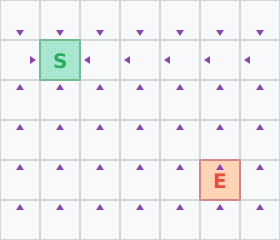
Each arrow points to parent: the cell that discovered it.
Reconstructing the Path
Use a stack to reverse the parent pointers!
The Neighbor Function
Two design decisions:
- Candidates: 4-connected? 8-connected? Knight moves?
- Validity: In bounds? Not a wall? Climbable?
Love Letters in the Mountains
Your Turn
Help Donkey find the shortest path to Dragon’s castle!
Complete the activity in PL to solve the puzzle!
The Story
Donkey must deliver a love letter to Dragon through mountainous terrain.
- Start at village S in a valley
- Deliver to Dragon’s castle E on a peak
- Each step: move to adjacent cell
- Constraint: Donkey can only climb one elevation level at a time!
aabqponm
abcryxxl
accszzxk
acctuvwj
abdefghi
(heights: a=0, b=1, …, z=25)
The Terrain Rules
From height h, you can step to a neighbor with height at most h + 1.
- From
a(height 0): can reachaorb - From
c(height 2): can reacha,b,c, ord - From
z(height 25): can reach anything!
This changes what “neighbors” means.
Part 1: Exploring the Valley
Question: Starting from S, how many locations can the messenger reach in at most 10 steps?
This is BFS with a step limit.
Part 2: Finding the Castle
Question: What is the shortest path from S to E?
This is BFS for shortest path.
(Stop when we reach E, return the distance.)
Part 3: The Scenic Route
Donkey wants to start from a valley—but which one?
Question: Which a cell has the shortest path to Dragon’s castle E?
A Clever Observation
Option 1: Run BFS from every a cell, take minimum. (Slow if there are many a cells!)
Option 2: Run BFS backwards from E.
- Use reversed edges: if A→B exists, search B→A
- Find all cells that can reach E
- Check which
acell is closest
Reversing the Edges
Forward edge (A can reach B): - From height h, can step to height ≤ h + 1
Backward edge (who can reach me?): - From height h, can step to height ≥ h - 1
Same algorithm, different neighbor function!
The Power of Abstraction
Both problems use the same BFS template:
- Bag: Queue (for shortest paths)
- Neighbors: Defined by terrain rules
- Termination: Goal reached or all reachable
Only the neighbor function changes!
Neighbors Are Everywhere
| Problem | “State” | Neighbors |
|---|---|---|
| Grid maze | (row, col) | Adjacent cells |
| Word ladder | “COLD” | Words 1 letter away |
| Tower of Hanoi | Disk positions | Valid moves |
| Rubik’s cube | Cube state | Single rotations |
| Social network | Person | Friends |
If you can define neighbors, you can search.
Summary: Whatever-First Search
The same algorithm works everywhere:
- Define your state (position, game configuration, …)
- Define neighbors (what’s reachable in one step?)
- Choose your bag:
- Stack → DFS (explore deeply)
- Queue → BFS (explore by distance)
- Priority queue → Best-first (explore by cost)
BFS with a queue finds shortest paths!
Lab Preview
In lab this week, you’ll implement:
- Tower of Hanoi game (state transitions)
- Sliding window problems (queue applications)
- Nearest smaller element (stack pattern)
- Histogram max area (stack application)
What’s Next
- Tuesday video: The Magic of O(1) Lookup — Dictionaries
- Wednesday: Dictionary Puzzles — Two-Sum, anagrams, frequency counting