Stacks
Week 5, Monday
February 2, 2026
A Big Question about Sorting
Can We Do Better?
We’ve seen:
- Insertion sort: \(O(n^2)\) (PEX1, HW1)
- Selection sort: \(O(n^2)\)
- Merge sort: \(O(n \log n)\)
Question: Is \(O(n \log n)\) the best we can do?
Or is there some clever algorithm that sorts in \(O(n)\)?
The Surprising Answer
Theorem: Any comparison-based sorting algorithm requires \(\Omega(n \log n)\) comparisons in the worst case.
This means:
- Merge sort is optimal
- No comparison sort can do better
- \(O(n \log n)\) is a fundamental barrier
Decision Trees
The Key Idea
Every comparison-based sort makes decisions by comparing pairs of elements:
if arr[i] < arr[j]:
    ...
else:
    ...
We can model the algorithm as a binary tree of decisions.
Example: Sorting 3 Elements
Suppose we want to sort \([v_1, v_2, v_3]\).
What the Tree Represents
- Internal nodes: Comparisons
- Edges: Answers (yes/no, or \(<\) / \(\geq\))
- Leaves: sorted ordering of the elements
- Height: running time of the algorithm
Note:
- There must be a leaf (endpoint) for each ordering of the elements
- the tree itself is an encoding of an algorithm
Counting Leaves
How many different rearrangements are possible for an \(n\) element list?
Each ordering needs its own leaf (otherwise we’d give the same answer for different inputs).
The decision tree must have at least \(n!\) leaves!
A Question for Later
Whose answer we need now…
A decision tree of height \(h\) has at most _______ leaves?
The Lower Bound Proof
Connecting Height to Comparisons
Recall: The height of the decision tree is the maximum number of comparisons in the worst case.
If the tree has height \(h\), then:
- At most \(2^h\) leaves
- We need at least \(n!\) leaves
Therefore: \(2^h \geq n!\)
Taking logarithms: \(h \geq \log_2(n!)\)
But How Big is \(\log(n!)\)?
Claim: \(\log(n!) = \Omega(n\log n)\)
Proof: \[ \begin{align} \log(n!) &= \log n + \log(n-1) + \cdots + \log 2 + \log 1 \\ &\geq \log n + \log(n-1) + \cdots + \log\left(\tfrac{n}{2}\right) & \text{(drop small half)} \\ &\geq \tfrac{n}{2} \cdot \log\left(\tfrac{n}{2}\right) & \text{(each term } \geq \log(n/2)\text{)} \\ &= \tfrac{n}{2}\log n - \tfrac{n}{2} \\ &= \tfrac{n}{4}\log n + \tfrac{n}{4}\log n - \tfrac{n}{2} \\ &\geq \tfrac{n}{4}\log n & \text{(when } \log n \geq 2 \text{, i.e., } n \geq 4\text{)} \\ &= \Omega(n \log n) \quad \blacksquare \end{align} \]
The Result
Observation: Any comparison-based sorting algorithm requires \(\Omega(n \log n)\) comparisons in the worst case.
Justification:
- Model the algorithm as a decision tree
- The tree needs at least \(n!\) leaves
- A tree with \(\geq n!\) leaves has height \(\geq \log_2(n!)\)
- \(\log_2(n!) = \Theta(n \log n)\)
- Therefore, worst-case comparisons \(\Omega(n \log n)\) ∎
What This Means
| Algorithm | Worst Case | Optimal? |
|---|---|---|
| Merge Sort | \(O(n \log n)\) | Yes! |
| Heap Sort | \(O(n \log n)\) | Yes! |
| Quick Sort | \(O(n^2)\) | No (but avg is optimal) |
| Insertion Sort | \(O(n^2)\) | No |
| Selection Sort | \(O(n^2)\) | No |
Merge sort achieves the theoretical limit.
Can We Beat \(O(n \log n)\)?
The lower bound applies to comparison-based sorts.
If we know something about the input, we can do better:
| Algorithm | Constraint | Time |
|---|---|---|
| Counting Sort | Integers in \([0, k]\) | \(O(n + k)\) |
| Radix Sort | Fixed-width integers | \(O(d \cdot n)\) |
In practice: Just use Python’s sorted() (Timsort, \(O(n \log n)\)).
Summary
- Labs this week will close up sorting.
- Sorting has been a good playground for examples.
Ordered Search
The Maze
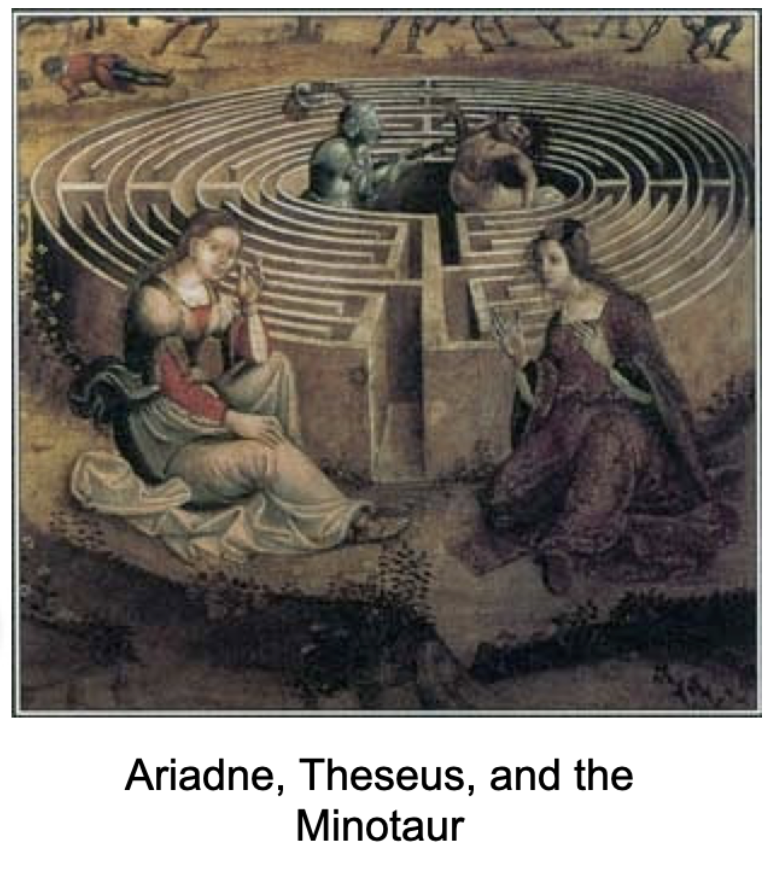
You wake up in a maze. Every room has a number. Some rooms have multiple exits.
Question: How do you explore systematically to find the way out?
What Did You Notice?
Write down everything you noticed:
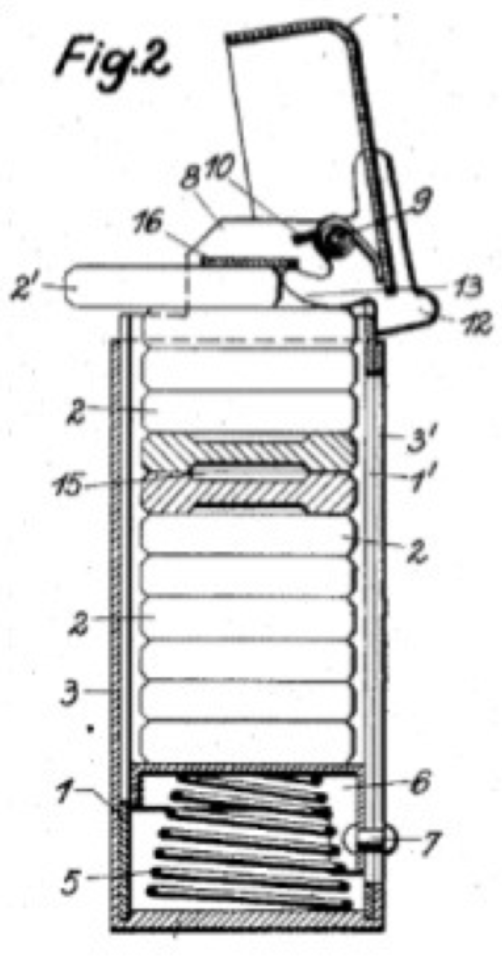
Abstract Data Type (ADT) Stack
Programmatic realization of a ________________.
Stack functions:
- Insert:
push(item) - Remove:
pop()\(\rightarrow\)item
List functions:
- Insert:
append(item) - Remove:
pop()\(\rightarrow\)item
Tuesday Video:
“Dynamic Array Diversion”