Binary Search
Week 3, Tuesday (Video)
January 20, 2026
The Twenty Questions Puzzle
The Game
I’m thinking of a number between 0 and 63.
You can ask yes/no questions.
What’s your guaranteed winning strategy?
How Many Questions?
Start with \(n = 64\) possibilities (0 to 63).
After each question: \(n \to n/2\)
Questions needed: \(\log_2(64) = 6\)
Let’s Play!
I’m thinking of a number between 0 and 63.
You can ask yes/no questions.
Binary Search
The Problem
Given a sorted array and a target value, find the target’s index (or determine it’s not there).
| 0 | 1 | 2 | 3 | 4 | 5 | 6 | 7 | 8 | 9 |
|---|---|---|---|---|---|---|---|---|---|
| 2 | 5 | 8 | 12 | 16 | 23 | 38 | 56 | 72 | 91 |
Find target = 23.
Linear Search: The Naive Approach
Worst case: \(\Theta(n)\)
Binary Search: The Clever Approach
Worst case: \(\Theta(\log n)\)
Tracing Binary Search
| 0 | 1 | 2 | 3 | 4 | 5 | 6 | 7 | 8 | 9 |
|---|---|---|---|---|---|---|---|---|---|
| 2 | 5 | 8 | 12 | 16 | 23 | 38 | 56 | 72 | 91 |
Find target = 23:
lo=0, hi=9, mid=4→arr[4]=16 < 23→lo=5lo=5, hi=9, mid=7→arr[7]=56 > 23→hi=6lo=5, hi=6, mid=5→arr[5]=23✓ → return 5
The 17-Year Bug
“I’ve assigned binary search in courses at Bell Labs and IBM… and I’ve studied their solutions… In the history of this exercise, only about ten percent of professional programmers have gotten the program right.”
— Jon Bentley, Programming Pearls (1986)
The first correct binary search was published in 1946.
The first bug-free implementation? 1962.
Proving Binary Search Correct
The Invariant
Invariant: If target is in arr, then target is in arr[lo:hi+1].
Equivalently: We haven’t excluded any index where target could be.
Base Case (Initialization)
Before the first iteration: lo = 0, hi = len(arr) - 1
arr[lo:hi+1] = arr[0:len(arr)] = entire array
If target is in arr, it’s in arr[lo:hi+1]. ✓
Key Fact: mid is Always Valid
Since lo <= hi (loop condition) and mid = (lo + hi) // 2:
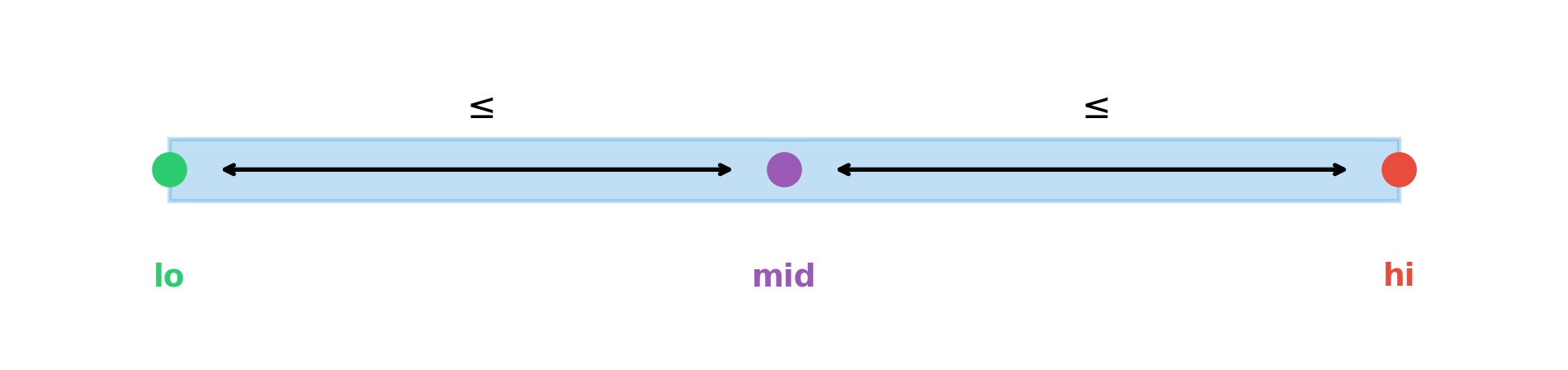
\[\texttt{lo} \leq \texttt{mid} \leq \texttt{hi}\]
This means arr[mid] is always a valid access inside the loop.
Inductive Step: Case 1 (Found it)
arr[mid] == target → we return mid.
Since lo <= mid <= hi, we know mid is in the search range.
We found the target and return its index. ✓
Inductive Step: Case 2
arr[mid] < target
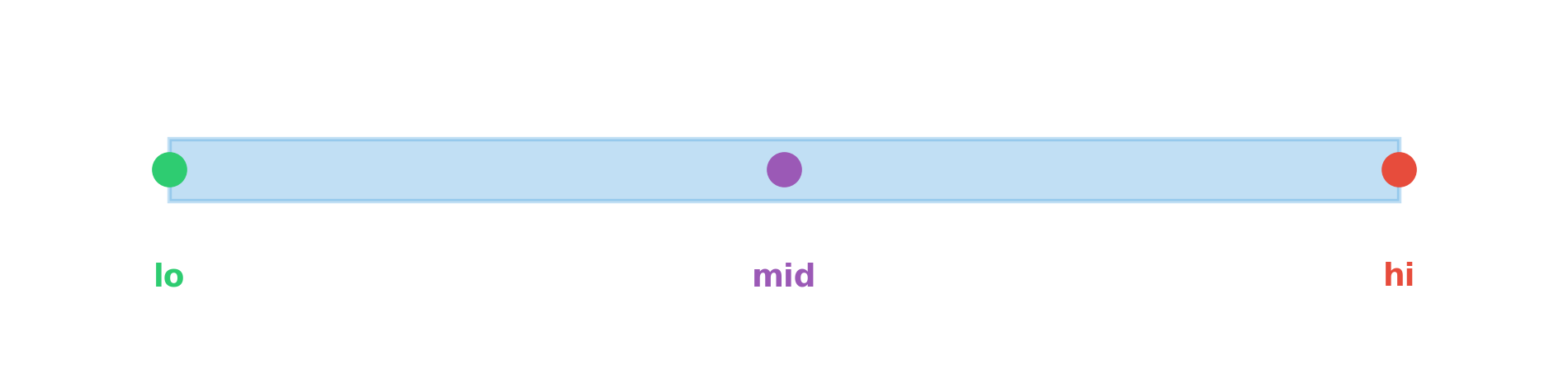
Setting lo = mid + 1 excludes only indices where target can’t be. ✓
Inductive Step: Case 3
arr[mid] > target
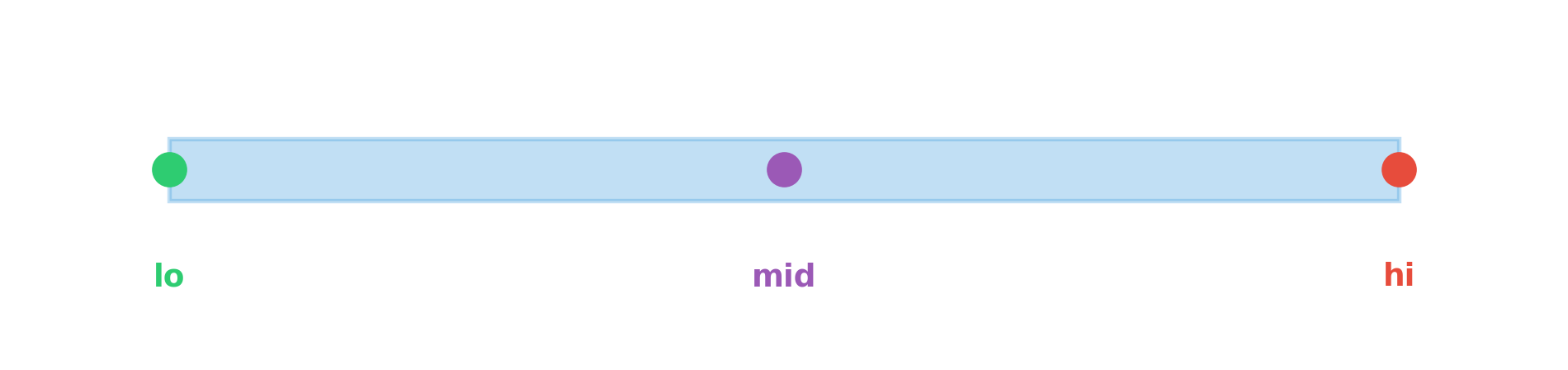
Setting hi = mid - 1 excludes only indices where target can’t be. ✓
Termination (Exit via lo > hi)
The loop exits when lo > hi.
At this exit point, arr[lo:hi+1] is empty.
The invariant says: if target is in arr, it’s in this empty range.
But nothing is in an empty range.
Therefore: target is not in arr. Return -1. ∎
The Proof in One Slide
Theorem: binary_search(arr, target) returns the index of target if present, else -1.
Proof: By induction on iteration count.
- Invariant: If
target ∈ arr, thentarget ∈ arr[lo:hi+1] - Base case: Initially, full array satisfies invariant ✓
- Inductive step: Each case either exits correctly or safely shrinks range ✓
- Termination: At exit, invariant \(\Rightarrow\) correct answer ∎
Why the Bug?
Common Mistakes
The Java Bug (2006)
When low + high > Integer.MAX_VALUE, this overflows.
Fix:
The Invariant Saves You
When you’re unsure about an edge case, ask:
“Does this maintain the invariant?”
lo = mid + 1: Does this exclude only impossible locations? Yes.hi = mid - 1: Does this exclude only impossible locations? Yes.lo <= hi: When does the search space become empty? When lo > hi.
Analysis
Worst-Case Running Time
Each iteration:
- Constant work (comparisons, arithmetic)
- Range shrinks by half: \((hi - lo + 1) \to \lfloor(hi - lo + 1)/2\rfloor\)
How many halvings until range is empty?
\(\log_2(n)\)
Worst case: \(\Theta(\log n)\)
The Scale Comparison
| \(n\) | Linear Search | Binary Search |
|---|---|---|
| 1,000 | 1,000 | 10 |
| 1,000,000 | 1,000,000 | 20 |
| 1,000,000,000 | 1,000,000,000 | 30 |
Racing Them
The Race
The Price of Speed
The Precondition
Binary search requires the array to be sorted.
What if it’s not sorted?
When to Use Binary Search
Use binary search when:
- Data is sorted (or can be sorted once, searched many times)
- Random access is \(O(1)\) (arrays, not linked lists)
- You need to find a specific value
Don’t use when:
- Data is unsorted and searched only once
- Data structure doesn’t support random access
- You need to find all occurrences
Summary
What We Learned
Binary search finds a target in \(\Theta(\log n)\) time (vs \(\Theta(n)\) for linear)
The invariant: “If target exists, it’s in
arr[lo:hi+1]”The proof: Init, Maintenance (3 cases), Termination
The bugs: Off-by-one errors, infinite loops, integer overflow
The precondition: Array must be sorted
Wednesday
Recursion: When the function calls itself.
- Thinking recursively
- Binary search, recursively
- The fractal coastline puzzle
Questions?
Binary search: \(\Theta(\log n)\)
The invariant makes it correct.
The halving makes it fast.