The Invariant Detective
Week 3, Monday
January 19, 2026
Warm-up: A Frozen Algorithm
The Scene
An algorithm was running, but we paused it mid-execution.
Your job: figure out what it was doing and where it stopped.
Puzzle 1: Find Maximum
Puzzle 1: Find Maximum
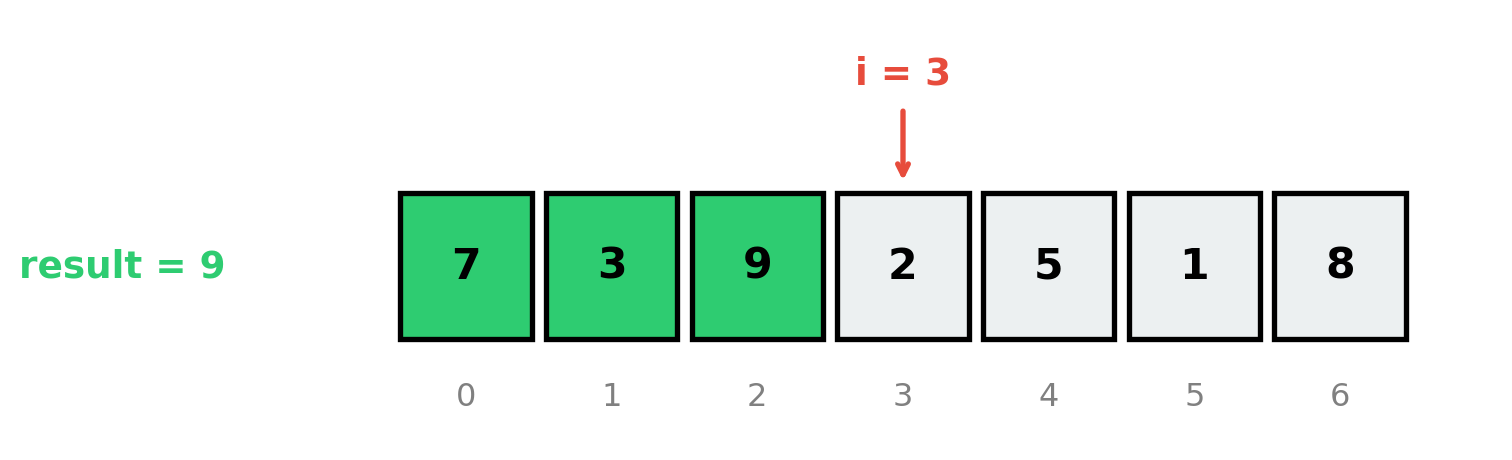
| 0 | 1 | 2 | 3 | 4 | 5 | 6 |
|---|---|---|---|---|---|---|
| 7 | 3 | 9 | 2 | 5 | 1 | 8 |
Variables: result = 9
Q1: What iteration is i about to start?
Q2: What does result represent?
The Solution
i = 3(about to examine index 3)result = 9= maximum ofarr[0:3]= maximum of[7, 3, 9]
The Invariant: At iteration \(i\), result holds the maximum of arr[0:i].
Why This Works
The invariant tells us:
- At i = 1:
result= max ofarr[0:1]= max of[7]= 7 ✓ - At i = 2:
result= max ofarr[0:2]= max of[7, 3]= 7 ✓ - At i = 3:
result= max ofarr[0:3]= max of[7, 3, 9]= 9 ✓
The frozen state is consistent with the invariant at i = 3.
Puzzle 2: Counting
Puzzle 2: Counting
| 0 | 1 | 2 | 3 | 4 | 5 | 6 |
|---|---|---|---|---|---|---|
| 4 | 8 | 2 | 7 | 1 | 9 | 3 |
Variables: count = 2
Q1: What iteration is i about to start?
Q2: State the invariant.
The Solution
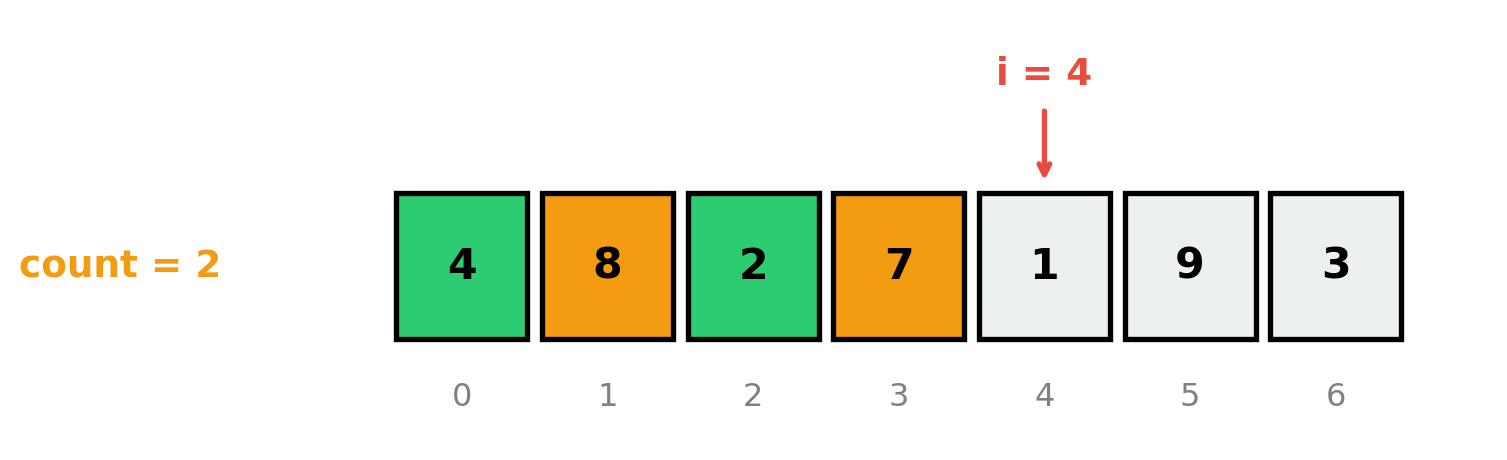
- Elements > 5 in
arr[0:4]=[4, 8, 2, 7]: 8 and 7 → count = 2 i = 4
The Invariant: At iteration \(i\), count equals the number of elements > 5 in arr[0:i].
Puzzle 3: Partitioning
Puzzle 3: Partitioning
Original: [5, 8, 2, 9, 1, 7, 3]
| 0 | 1 | 2 | 3 | 4 | 5 | 6 |
|---|---|---|---|---|---|---|
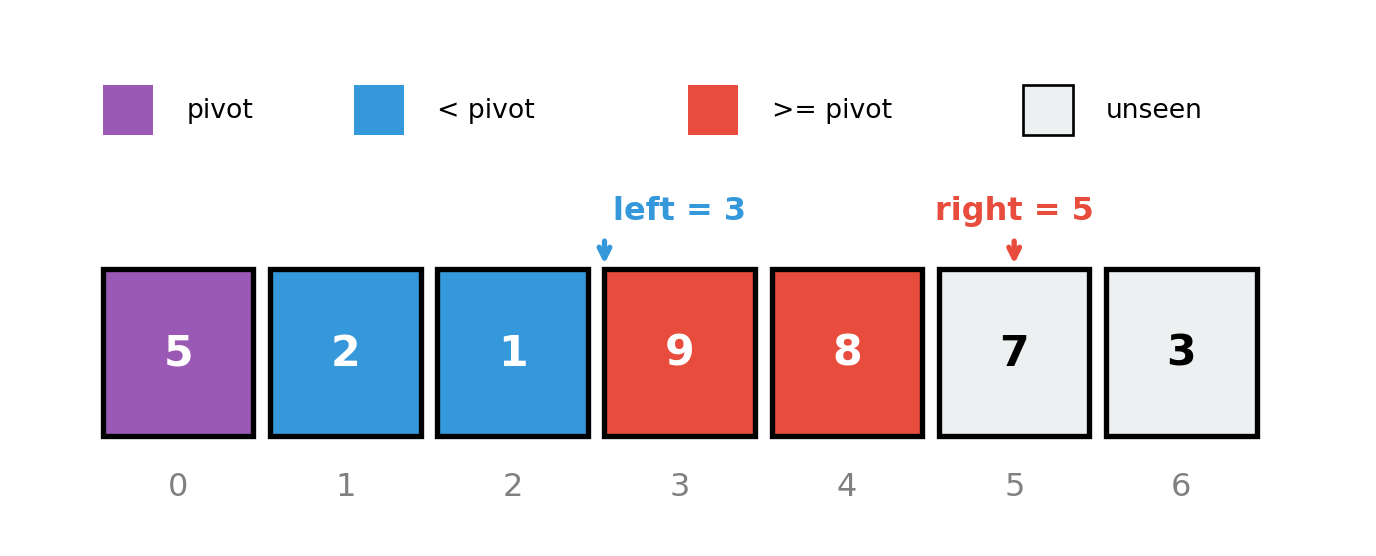
| 5 | 2 | 1 | 9 | 8 | 7 | 3 |
pivot = 5, left = 3
Q1: What iteration is right about to start?
Q2: Describe what’s in arr[1:left] and arr[left:right].
The Visualization
The Solution
right = 5(about to examine index 5, which has value 7)arr[1:left]=arr[1:3]=[2, 1]— all < pivot (5)arr[left:right]=arr[3:5]=[9, 8]— all >= pivot (5)
The Invariant (at iteration right):
arr[1:left]contains elements < pivotarr[left:right]contains elements >= pivotarr[right:]is unexamined
The Detective Method
How to Find Invariants
Look at the loop variable: What does
i(orright, etc.) represent?Look at the accumulated state: What has
result,count,leftcaptured so far?State the relationship: “At iteration \(i\), [variable] holds [property of arr[0:i]]”
Verify: Does the frozen state match your invariant?
Common Invariant Patterns
| Pattern | Example Invariant |
|---|---|
| Accumulation | “total = sum of arr[0:i]” |
| Extremum | “max_val = maximum of arr[0:i]” |
| Counting | “count = number of X in arr[0:i]” |
| Search | “If target exists, it’s in arr[lo:hi+1]” |
| Partition | “arr[0:left] satisfies P, arr[left:i] doesn’t” |
Practice: You Try
Puzzle 4
| 0 | 1 | 2 | 3 | 4 | 5 | 6 | 7 |
|---|---|---|---|---|---|---|---|
| 2 | 3 | 1 | 4 | 5 | 2 | 3 | 1 |
Variables: total = 14
Q1: What is i? Q2: State the invariant.
Solution 4
\(2^2 + 3^2 + 1^2 = 4 + 9 + 1 = 14\)
So i = 3 (about to process index 3).
Invariant: At iteration \(i\), total = sum of squares of arr[0:i].
Puzzle 5
Frozen state: lo = 5, hi = 9, target = 72
| 0 | 1 | 2 | 3 | 4 | 5 | 6 | 7 | 8 | 9 | 10 | 11 | 12 | 13 | 14 | 15 |
|---|---|---|---|---|---|---|---|---|---|---|---|---|---|---|---|
| 2 | 5 | 8 | 12 | 16 | 23 | 38 | 56 | 72 | 91 | 95 | 99 | 103 | 110 | 125 | 142 |
Q1: What just happened? Q2: State the invariant.
Solution 5
- We’re searching for 72
lo = 5, hi = 9means we’re looking inarr[5:10]=[23, 38, 56, 72, 91]- Previous mid was 4 (value 16 < 72), so we set
lo = 5
Invariant: If target is in arr, then target is in arr[lo:hi+1].
Why This Matters
Debugging with Invariants
When your code doesn’t work:
- State your invariant (what should be true?)
- Print the state at each iteration
- Find where the invariant breaks
The bug is where reality diverges from the invariant.
The Invariant as Compass
“When lost, check the invariant.”
- Unsure about an edge case? → Does it maintain the invariant?
- Code gives wrong answer? → Where does the invariant fail?
- Writing new code? → What invariant do I want to maintain?
Summary
What We Learned
Invariants are discoverable from frozen states
The pattern: “At iteration \(i\), [variable] holds [property of data seen so far]”
Common types: accumulation, extremum, counting, search range, partition
The detective method: Look at loop variable, look at accumulated state, state the relationship
Next Time
Recursion: When the function calls itself.
Spoiler: Recursion has invariants too — we call them recursive properties.