EX2 is Thu 10/8 through Sun 10/11, in ORCA. It covers lectures 6 through 10. Practice problems are on PrairieLearn.
The lecture 10 video was re-recorded: the first upload had no audio.
Tutorials meet this week.
Friday’s Question
Is the converse true? Is every perfect square a glow number?
Sudoku Warm Up
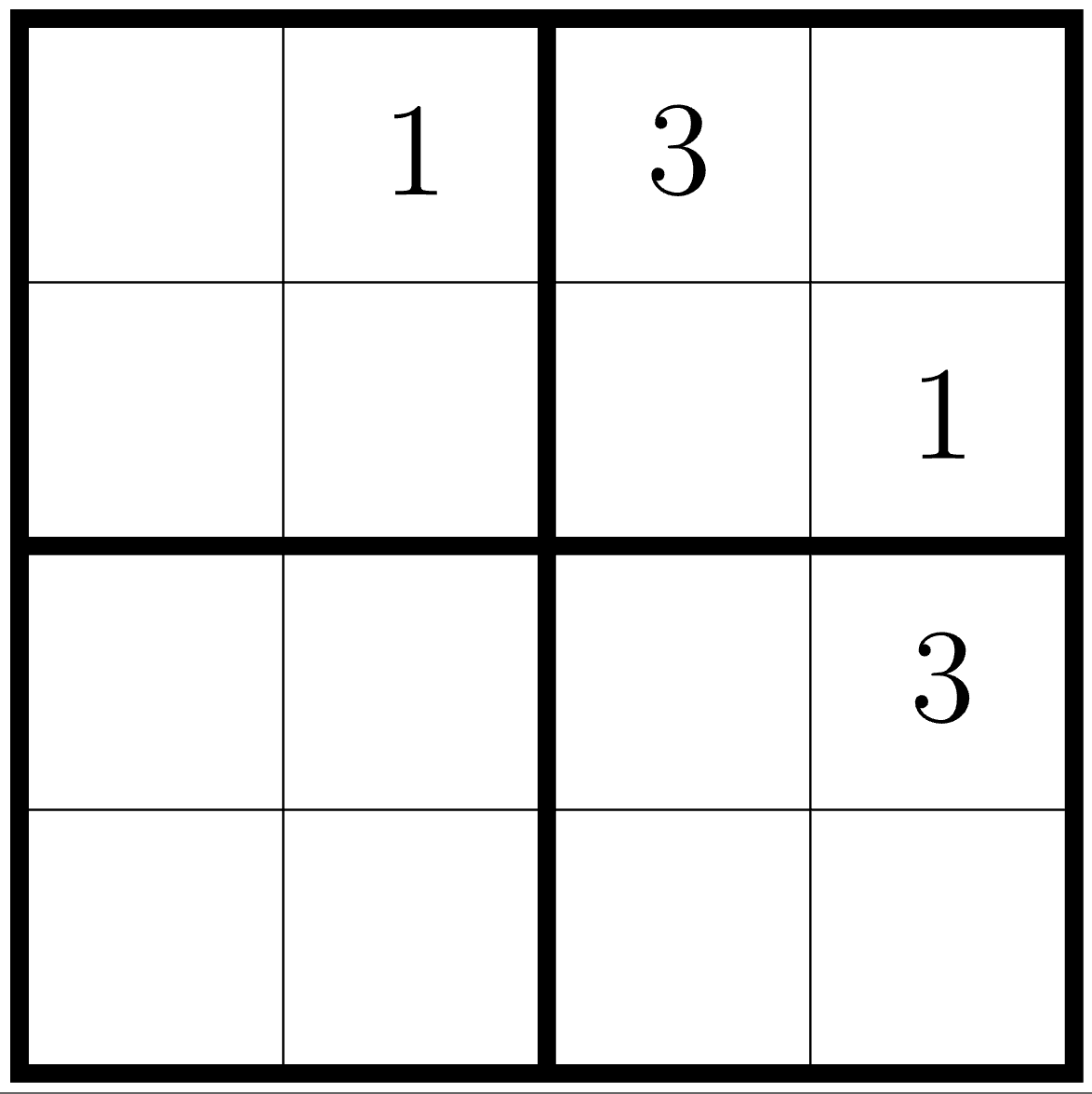
In a 4x4 Sudoku, each row, each column and each 2x2 box contains each of 1, 2, 3 and 4 exactly once.
Solve the Sudoku on the worksheet.
Speculate on an interesting feature of the corners.
Do all 4x4 Sudoku puzzles have this feature?
Corners and Centre
Do all 4x4 Sudoku puzzles have THIS feature?
\(\to\) Sudoku: Direct
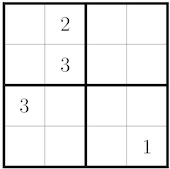
Prove that for any solution to this mini sudoku, if the solution has a 2 in the top-left square (r1c1), then it has a 2 in the bottom-right square (r4c4).
\(\leftrightsquigarrow\) Sudoku: Contrapositive
Theorem: For any valid Sudoku solution, if A and B and C are not 4, then D is 4.
Contrapositive:
↯ Sudoku: Contradiction
Prove that any solution to this mini sudoku has a 3 in the top-right corner (r1c4).
Proof by Induction
Today’s goals
Understand role of components of an inductive proof.
Write short inductive proofs.
Warm Up
A Tower is built by stacking 5m red panels, and 7m blue panels.
What tower heights are possible? Talk it through with the people around you: which heights can you build, and which can’t you?
Warm Up Continued
Claim: for all integers \(n > 23\), we can build a tower of height \(n\) using only 5m red and 7m blue panels.
Height
Red
Blue
24
25
26
27
28
Every height \(n \geq 29\): ____________________________
Inductive Proof Skeleton Card
Proof by Induction of \(\forall n, P(n)\)
First line: “Consider an arbitrary n.”
Second line (IH): “Assume \(\forall j < n, P(j)\).”
Determine exhaustive cases for \(n\), including one or more base cases and usually one inductive case.
Prove each case, base and inductive, independently. Base case is typically direct, and inductive case will require use of IH.
Proof by Induction
Claim: For any integer \(n > 0\), \(\sum\limits_{k=1}^{n} k^2 = \frac{n(n+1)(2n+1)}{6}\).
Proof: Consider an arbitrary integer \(n > 0\).
IH: Assume inductively that for any \(j<n\), \(\sum\limits_{k=1}^{j} k^2 = \frac{j(j+1)(2j+1)}{6}\).
Either \(n=1\), or \(n>1\).
Case 1 \((n=1)\):
Case 2 \((n>1)\):
Your turn!
Claim: For any \(n>0\), \(\sum\limits_{k=1}^n \frac{1}{(2k-1)(2k+1)} = \frac{n}{2n+1}\).