Logical Equivalences
Lecture 3, DSCI 220, 2026W1
Announcements
Tutorials begin this week.
- L1D Tue 2–4 ORCH 3002
- L1B Tue 4–6 ORCH 3002
- L1A Wed 1–3 SPPH 143
No class this Friday. Video released by Thursday morning.
HW1 available, due Sunday, Sep 20.
EX1 next week (end of week 3). Sign up on PrairieTest — link to come.
Propositions Continued
Parse Trees
Apply the outermost relevant rule…
\(((\text{Tu} \wedge \text{Th}) \wedge (\text{Sa} \vee \text{Su}))\)
\((\text{Tu} \wedge (\text{Th} \wedge (\text{Sa} \vee \text{Su})))\)
WFFs
Theorem: \(\neg (p ∨ q))\) is not a WFF.
Proof:
Back to Propositions
A proposition is a statement that can be either True or False.
Examples:
\(37 > 12\)
Fewer than 5 people in this room feel sleepy.
There are extra-terrestrial life forms.
This statement is False.
\(\underline{\hspace{10em}}\)
Translation
From English to logic and back…
\(p\): ___________ ate cereal for breakfast.
\(q\): ___________ brought a backpack to class.
\((p\lor q)\)
\((p\wedge q)\)
\(\neg q\)
Logical Equivalence
Logical Equivalence
Ex: Is it true that \((p \lor q) \equiv (q\lor p)\) ?
Ex: Is it true that \(((\text{Tu} \wedge \text{Th}) \wedge (\text{Sa} \vee \text{Su})) \equiv (\text{Tu} \wedge (\text{Th} \wedge (\text{Sa} \vee \text{Su})))\) ?
Discussion points:
\(\equiv\) means logically equivalent
The answer had better be _________!!!
How can we justify our instinct?
Logical Equivalences
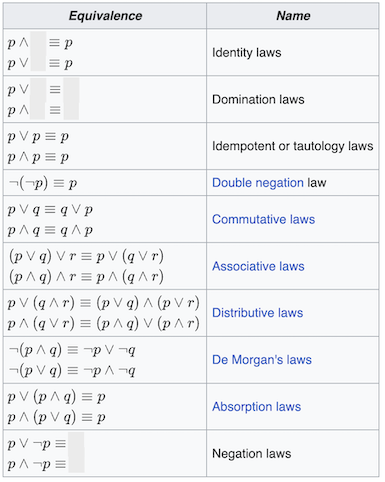
We have discussed Logical Equivalence (LE) and explored an example. The table illustrates LE that are so important, they have names!
Eight cells are missing. What belongs in them?
Observations:
Special Logical Equivalences
Suppose \(p\equiv\) T . Then \(p\) is a Tautology.
Suppose \(p\equiv\) F . Then \(p\) is a Contradiction.
Logical Equivalence
Suppose we have the following propositions, and someone has asserted that for Cheerios, \(\neg(p\lor q)\). How is this expressed in English? Can you find a simpler expression?
\(p\): a cereal has less than 4 units of protein
\(q\): a cereal has more than 6 units of sugars
DeMorgan’s tells us \(\neg p\wedge \neg q \equiv \neg( p\lor q)\).
| \(p\) | \(q\) | \(\neg p\wedge \neg q\) |
|---|---|---|
| F | F | |
| F | T | |
| T | F | |
| T | T |
| \(p\) | \(q\) | \(\neg( p\lor q)\) |
|---|---|---|
| F | F | |
| F | T | |
| T | F | |
| T | T |
Simplified statement:
Chains of Equivalence
Prove that
\[(((p \wedge q) \wedge r) \vee ((p \wedge q) \wedge \neg r)) \;\equiv\; (p \wedge q)\]
\(\equiv\)
\(\equiv\)
\(\equiv\)
Logical Equivalence Practice
Navigate to Activity 3 and complete question 1. Each of you will receive a different version of the problem. Work together in pairs to solve each person’s version.
Words and Ideas
Grammar
Logical Equivalence
Tautology, Contradiction