Programming, problem solving, and algorithms
CPSC 203, 2025 W2
April 2, 2026
Announcements
Text as Data
From Last Time
Resource for our nlp tool: spaCy
Key observation: when a big string of text is run through the processor, many, many attributes are introduced!
Last time we counted word “token”s. Today: POS and NER.
Parts of Speech
Helps us understand the meaning of language.

Parts of Speech
Open class — new words can always be added: Noun, Verb, Adjective, Adverb
Closed class — fixed, finite set: Preposition, Conjunction, Pronoun, Interjection
Nouns subdivide: proper (Emma, Hartfield) vs common (village, house)
→ Proper nouns are often named entities — this is our bridge to NER
POS Tagging is Hard
The word “curling” can be three different things depending on context:
Plug in the curling iron. → adjective (JJ)
I want to learn to play curling. → noun (NN)
The ribbon is curling around the Maypole. → verb (VBG)
spaCy POS: Two Levels
spaCy gives you two levels of detail on every token:
| Attribute | Grain | Example values |
|---|---|---|
token.pos_ |
Coarse (universal) | NOUN, VERB, PROPN, ADJ, ADP |
token.tag_ |
Fine (Penn Treebank) | NN, VBD, NNP, JJ, IN |
For the sentence “Emma lost no time.”:
PROPN: proper noun, a signal that this token might be a named entity
From POS to Named Entities
POS tagging labels every token individually.
But named entities are often multi-word spans: “Mr. Knightley”, “Hartfield”, “Emma Woodhouse”
NER goes farther: it groups tokens into spans and assigns a category:
PERSON— people and charactersLOC/GPE— placesORG— organizations
Named Entity Recognition
Essentially: tagging proper nouns
NER used for inferring relationships between entities:
- PERSON lives LOCATION
- LOCATION has ORGANIZATION
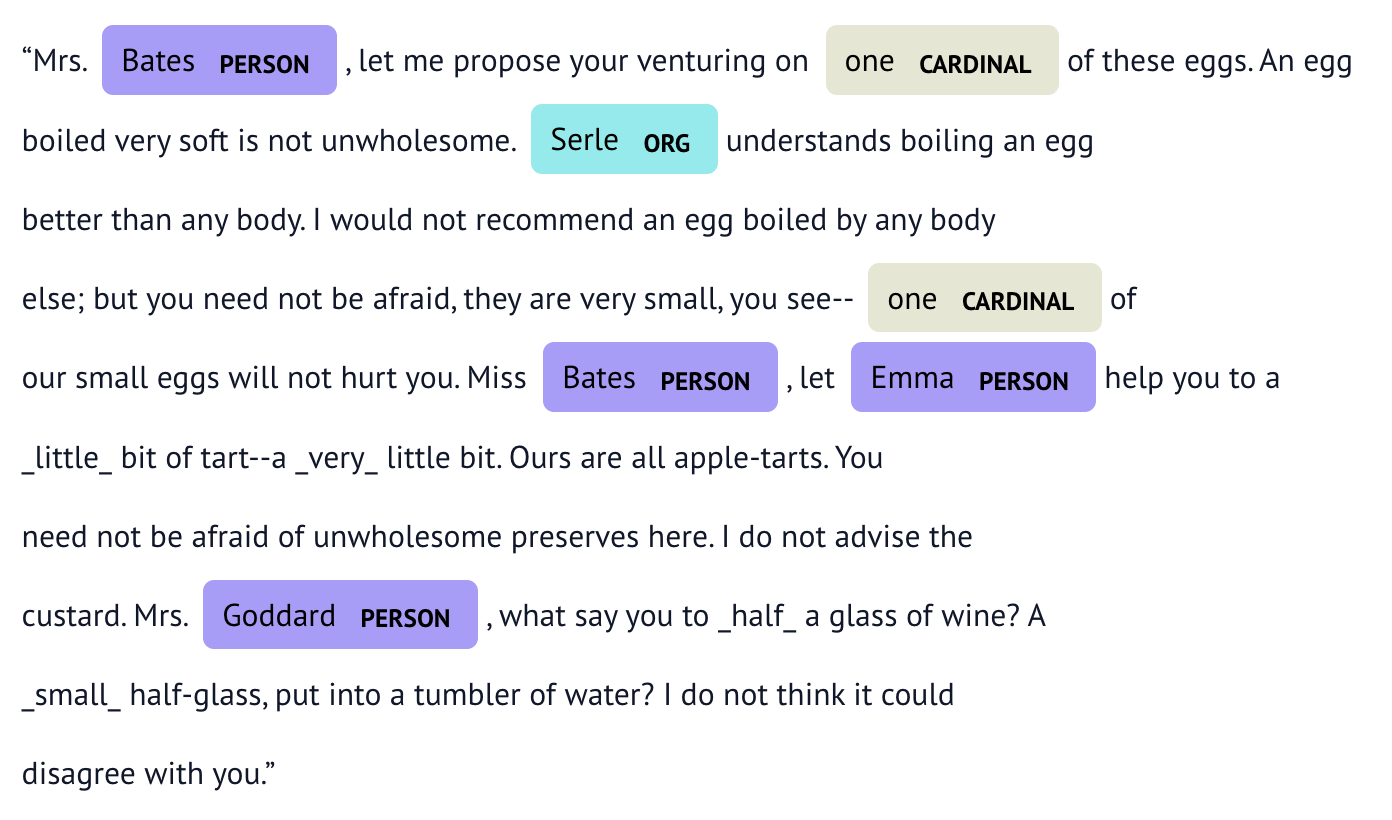
NER
- Underline all of the proper nouns (named entities) in this text:
Harriet Smith’s intimacy at Hartfield was soon a settled thing. Quick and decided in her ways, Emma lost no time in inviting, encouraging, and telling her to come very often; and as their acquaintance increased, so did their satisfaction in each other. As a walking companion, Emma had very early foreseen how useful she might find her. In that respect Mrs. Weston’s loss had been important. Her father never went beyond the shrubbery, where two divisions of the ground sufficed him for his long walk, or his short, as the year varied; and since Mrs. Weston’s marriage her exercise had been too much confined. She had ventured once alone to Randalls, but it was not pleasant; and a Harriet Smith, therefore, one whom she could summon at any time to a walk, would be a valuable addition to her privileges. But in every respect, as she saw more of her, she approved her, and was confirmed in all her kind designs.Typical categories of entities are PERSON, LOCATION, ORGANIZATION. Think about how you might discover each of the entities using a program.
IOB Encoding
NER marks which tokens belong to an entity using IOB tags:
| Tag | Meaning | Example |
|---|---|---|
B |
Beginning of an entity | ('Harriet', 'B', 'PERSON') |
I |
Inside (continuing) an entity | ('Smith', 'I', 'PERSON') |
O |
Outside — not part of any entity | ('was', 'O', '') |
So “Harriet Smith was late” becomes:
NER with SpaCy
- The PL activity contains a file called
ner_nb.py. Modify and execute this file to answer the following questions. In each case, sketch an example of the output, and explain it briefly in English.
load a OFK excerpt from
ofk_ch1Short.txtcreate a spaCy doc object with
doc = nlp(textRaw)
NER with SpaCy
If
docis the result of part b, What doessents = list(doc.sents)do?If
sentsis the result of part c, what doessentWords = [[token.text for token in sent] for sent in sents]do?If
sentsis the result of part c, what doessentWordsPOS = [[(token.text, token.pos_) for token in sent] for sent in sents]do?
NER with SpaCy
If
sentsis the result of part c, what doesents_by_sent = [[(ent.text, ent.label_) for ent in sent.ents] for sent in sents]do?If
sentsis the result of part c, what doessentWordsNER = [[(token.text, token.ent_iob_, token.ent_type_) for token in sent] for sent in sents]do?If
docis the result of part b, what doesnames = [ent.text for ent in doc.ents if ent.label_ == "PERSON"]do?