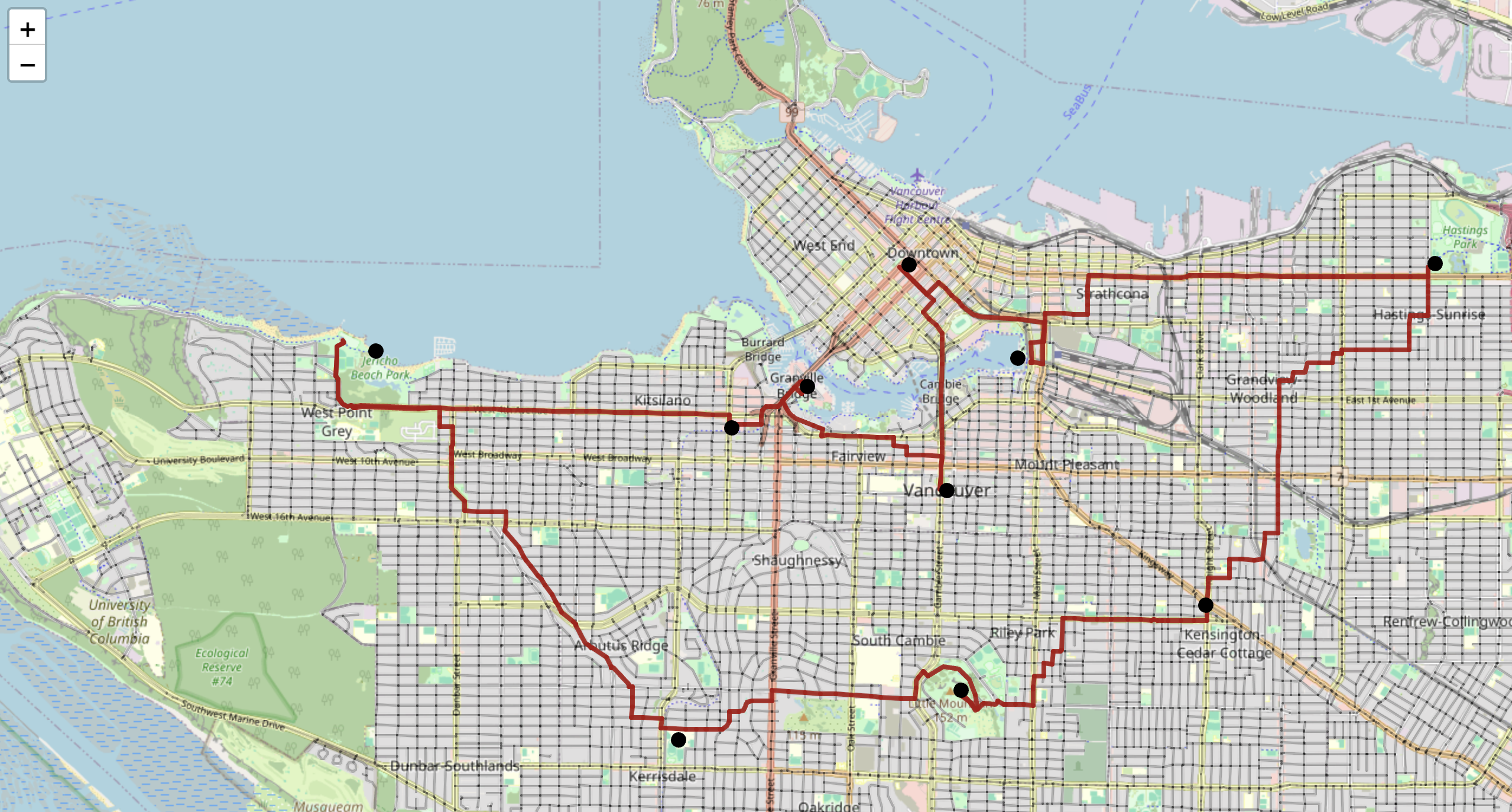
Travelling Salesperson Problem – CODE!
TSP vs SSSP
SSSP: “many one-way routes from home (tree)” vs TSP: “one big round trip through everyone (loop)”
TSP vs SSSP
| Goal |
Shortest route from one start to each vertex |
One cheapest tour visiting all vertices and returning |
| Shape |
Tree of paths from the source |
Cycle through all vertices |
| Must visit all? |
No – each path can skip most vertices |
Yes – must visit every vertex exactly once |
| Overlap |
Paths often share edges |
Tour is one sequence; no repeated visits |
| Difficulty |
Fast algorithms (e.g., Dijkstra) |
NP-hard; exact solution is hard for large graphs |
Plan for Code
Steps to assemble our solution:
________________________________________
________________________________________
________________________________________
________________________________________
________________________________________
2. Create pairwise distances
What structure should we use?
dist['Vancouver']['Bellingham'] -> int
path['Vancouver']['Bellingham'] -> list
example: dist['Van']['Bel'] = nx.shortest_path_length(G, 'Van', 'Bel', weight='length')
3A. Create all possible orders
tours = list(itertools.permutations(list(dferrands['node'])))
![]()
3B. Tour Distance
We assemble each candidate solution as an arrangement of all of the errands:
Ex: A D B E F C
How do we find the total distance if we do the errands in the suggested order?
dfdist[A][D] + dfdist[D][B] + ... + dfdist[C][A]
![]()
Why This Matters
There are lots of applications:
- 📦 UPS/FedEx/Amazon Delivery Millions saved by reducing even 1km per driver per day.
- 🍔 UberEats/DoorDash/Skip Multi-stop pickup/delivery with time windows.
- 🧬 DNA Sequencing & Genome Assembly Ordering fragments relies on TSP-like reconstruction.
- 🚌 School Bus Routing Minimize buses, fuel, and time while meeting constraints.
- 🧪 Medical Lab Sample Pipelines Robotic arms schedule efficient multi-station workflows.
- ❄️ Snowplow & Garbage Truck Routing Efficiently cover every street in a city.
- 🏭 Factory Robots & CNC Machines Optimizing tool paths reduces waste, heat, and wear.
- ✈️ Airline Crew Scheduling Complex daily routing: crews must return to base, meet rest rules.
- 🌍 City Infrastructure Planning Utility inspections, meter reading, streetlight repair routes.
- 🚑 Ambulance & Emergency Routing Minimize response times; life-critical optimization.